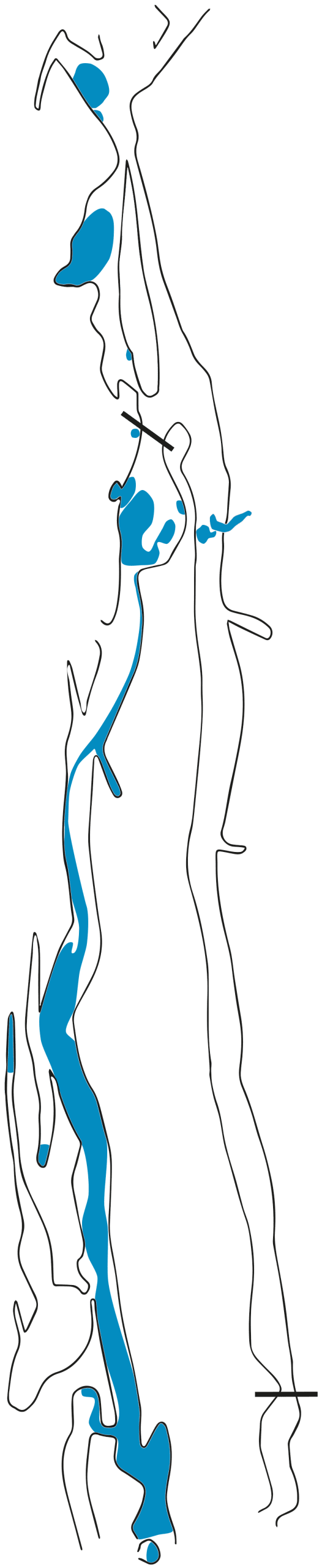
We are about to enter the “Grande Grotte” (the Great Cave), which houses cave paintings dating back around 28,000 years (the oldest in France after those of the Chauvet cave in Ardèche, and the oldest still visible in situ). This cave is not alone on the site; it is part of a group of eleven prehistoric caves whose entrances line the path along the river. The others are closed today because they protect archaeological remains (Magdalenian engravings in the Horse Cave…) or even bats. All these caves were dug by the Cure (show the river, behind the visitors). The Great Cave is the only one accessible to the public. We will spend about an hour there, for a journey of 450m outward, 450m return – or a little less than a kilometer of walking underground.
Rules
During the tour you are expected not to drink, eat, smoke, take pictures and make a film. Please be quiet and follow your guide advices.
Great Desert Room
They are more than thirty caves than can be called “Caves of Arcy”, 11 are prehistoric and two of them contain prehistoric drawings. Our tour takes place in the Great Cave which is the only one opened to the public. Earth quakes created big cracks inside the reef. Thanks to those cracks, a part of the Cure (the river you may have seen along the parking) could enter the reef. This water created the cave by passing through the massive for thousands of years. The pictures you can see on the wall represent some of the prehistoric drawings found in this cave. The first one has been discovered by mister Pierre Guilloré in April 1990. More than 170 have been listed since then. The Cave is divided in two galleries: a high one is the “fossil gallery” with paintings and a low one, the “living gallery” with two lakes.
Virgin room
Many of the names given to the concretions in from the imagination of the people that preced us. ln this case, the main stalagmite seems to look like mother Mary with her child. ls a reminder on how speleothems are formed: rain water passes through the limestone karst and absorbs calcium in its way. Once in the cave, water evaporates and creates little deposits of calcium. Step by step, and depending on many variables, that sediment takes the shape of various concretions. The count de Georges-Louis Leclerc Buffon, a famous naturalist who visited the cave in 1740, called these forms congelation or icicles. They were believed to be made of alabaster. The formations that grow from the ceiling to the floor are called Stalactites, not to be confused with Stalagmites which are the opposite as they grow from the floor to ceiling. The ones that are jointed are called columns. Drapery are concretions that form on the side of walls like little curtains, and soda straws are very thin but long stalactites. Leaving this room, on your right you will observe the largest stalactites that hang like ham and other curing meats. That is why it was called the butcher stall. And on your left, a concretion that looks like a medusa (jelly fish) was drawn on the first map of the cave which was made in 1787 by mister François Pasumot.
Scallop shell
ln this passageway you are looking at a large concretion without a base and on its underside, you can see an imprint of fossilized sediments left by the receding river. lt is called the St. Jacques hat or shell. This is a reminder that Arcy-sur-Cure and Vézelay were atone time on the path of the famous pilgrimage of Compostella.
Ballroom
This is the biggest room of the cave : it measures 12 meters high and 30 meters long. lt is famous for its fabulous acoustics. Last century, it was also widely known by the town folks for the famous celebration of the annual party that was given You can also see the oldest column of the Great Cave named the Calvary. It is the symbol of Arcy which we see on old posters. On the side you will see another concretion called the Church Organ. As well, you wiII note a large amount of guano in this room, attesting to the fact that this room used to be a major bat sanctuary. Disturbed by the visitors, they eventually left and they are known to be in another cave called “La grotte des Fées”, which is enclosed by an iron gate and houses a colony of at list 300 hundreds bats.
Rockslide room
Traces of big block falling off the ceiling in a random way give the impression of chaos. One of the walls presents a specific erosion facies called “les coups de gouge” (asymmetrical hollows). At the base of the scree, 2 meters above the ground, we find the claws of cave bears that have climbed on it. The scree was therefore already present when the cave bears frequented the cave. The cave bear became extinct about 11,500 years ago. During decades, people came to visit with torches and so blackened the cave. ln 1976, as a consequence, it was decided to undertake a cleaning of the cave with high-pressure water. Unfortunately, this cleaning had irreversible consequences: archeologists attest that about 80% of the paintings were damaged by this process.
Sea waves room
lt is named after the largest pools of water giving the impression of waves on the seashore. They are called rimstone dams or gours. As we approach the end of the sanctuary, the light is dimmed for conservation purposes. Experts have found the largest concentration of paintings with over 170 graphie representations, of which many are not accessible. These paintings are estimated to be 28 000 years old. They rank second oldest after the Chauvet’s Cave (in south of France), and older than Lascaux and both are closed to the general public. Three different colors of pigments are used in Arcy : red is made with burnt ocher, black is made with coal and grey is made with magnesium. Dangerous animals, mainly mammoths and large megaceros are represented. Most of the paintings were hidden under a layer of white calcite. To make them visible, they applied a new method consisting of patiently removing the opaque calcite mechanically with a dentist drill.
Lake
The last lake is shallow. Archeological digs have revealed many Gallo-roman remains, such as coins and pottery. Scientists declared that these remains might refer to offerings given to some divinity related to the water elements. And the mirror reflection on the water off the tormented sidewalls gives the effect unfer water of surprisinf landscapes of desolate mountains. Don’t let your imagination stop you from seeing other fabulous landscapes ! After the visit, we hope you will feel that there is not a better way to walk effortlessly through the library of time !
The end of the visit
Thank you for your visit. Think about the guide. The shop is open if you want to leave with a souvenir. See you soon !